How Is Hemp Flower Made? Harvest, Curing and Testing
By Treez
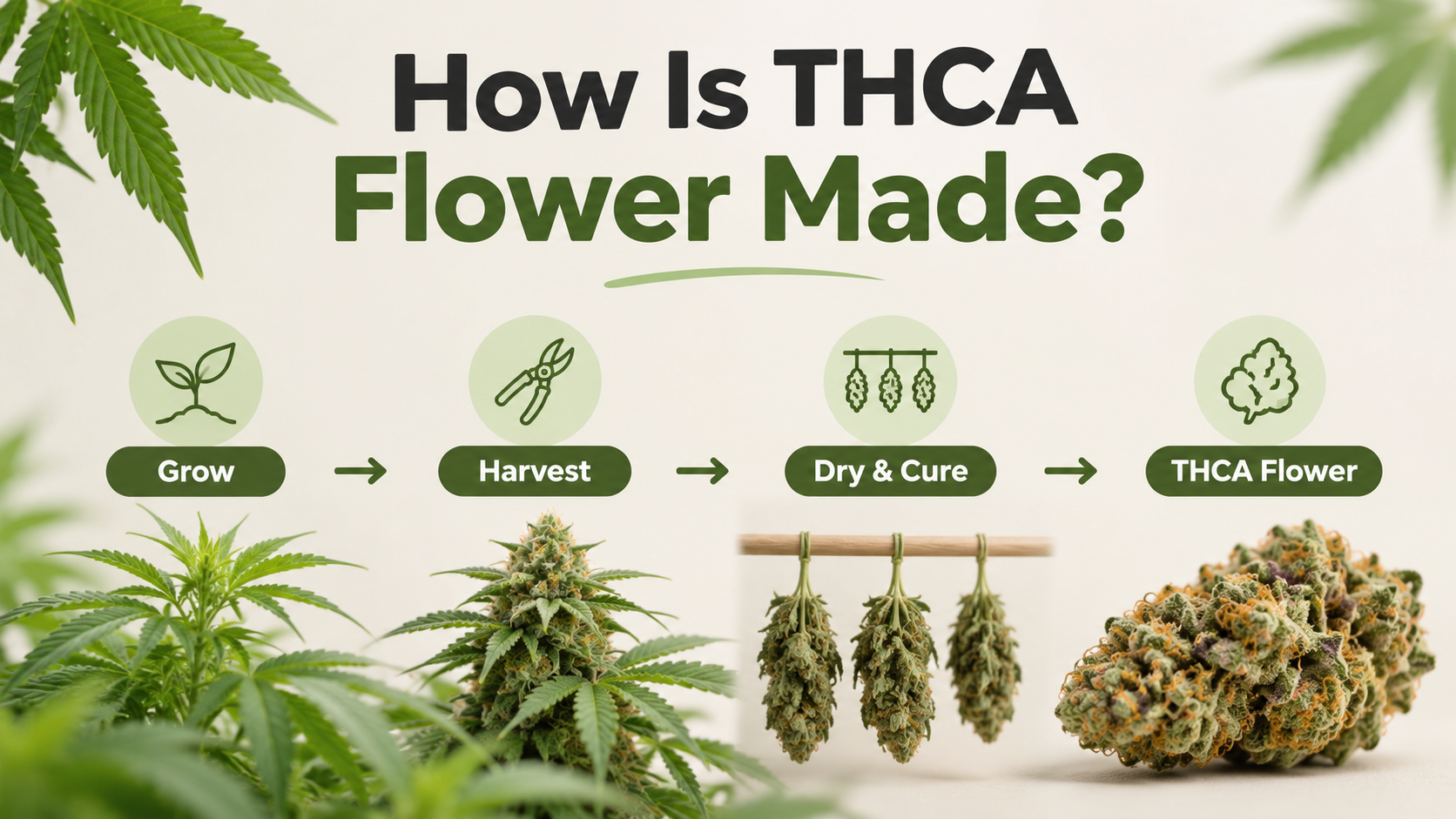
Hemp flower isn't made in a lab. The plant makes cannabinoids on its own, and growers harvest, dry, cure and test the flower. No chemical conversion is involved. What you see in the jar is the flower itself, with the hemp the plant produced while it grew. This post covers what happens from the plant's chemistry through harvest and testing. It does not cover seed selection or growing conditions.
This post explains how flower is grown and processed. It is not legal advice. For where hemp flower stands under Texas law, see our guide Is Hemp Flower Legal in Texas?
The Short Version
| Step | What happens |
|---|---|
| 1. Plant chemistry | The plant builds hemp inside tiny resin glands called trichomes. |
| 2. Harvest | Growers cut the plant when the flower looks mature. |
| 3. Drying | The flower dries slowly in a cool, controlled room. |
| 4. Curing | Dried flower rests in sealed containers so moisture evens out. |
| 5. Trimming and testing | Buds are trimmed, then a lab tests a sample and issues a COA. |
Step 1: The Plant Makes Cannabinoids
Hemp stands for tetrahydrocannabinolic acid. It forms in the glandular trichomes, the sparkly resin glands that cover cannabis flower.
The chemistry runs in a short chain. The plant first combines olivetolic acid with a geranyl group to make CBGA. The enzyme cannabinoid synthase then converts CBGA into cannabinoids. A 2005 study cited there found CBGA and cannabinoids together in the storage cavity of individual trichomes, supporting the idea that this cavity is where hemp builds up.
Two things follow from this:
- Genetics matter. Variation in the cannabinoid synthase gene is linked to whether a plant is a high-THC type or a fiber type.
- Hemp is not made by heating. Heat does the opposite: heating or vaping converts cannabinoids into Delta-9 THC. Separately, the University of Georgia study described below found that acidic cannabinoids, cannabinoids most of all, also convert slowly during storage.
Step 2: Harvest
Growers pick a harvest day by looking at the flower. A common method is checking the trichomes with a magnifier. Clear trichomes are immature, cloudy or milky ones are generally treated as peak, and amber ones are further along. Advice on the exact mix varies, and one grower guide treats trichome color as one signal among several, not the only one. Most sources are grower guides rather than peer-reviewed studies, so treat any specific percentage as a rule of thumb.
Harvest timing affects more than potency. It shapes aroma, the feel of the effect, and how dense the buds turn out.
Step 3: Drying
After harvest, the plants or the cut branches are hung in a drying room. The goal is to remove moisture slowly. Dry too fast and the flower can lose aroma and turn harsh. Dry too slowly in damp air and mold becomes a risk.
A trade-press special report in Cannabis Business Times quotes a researcher who found an optimal drying-room window of 60 to 74°F (about 16 to 23°C) and 40% to 60% humidity, with 10 to 14 days working well for preserving terpenes. Terpenes are the aroma compounds in flower. This is one researcher's finding, not a universal standard.
Heat has a trade-off. A study on hemp flower from the University of Georgia (record) compared warm barn and oven drying (40 and 50°C) with a controlled room at 15°C and 60% humidity followed by a two-week cure. Total cannabinoids held steady after harvest, but acidic cannabinoids, cannabinoids most of all, converted during storage. The cultivar also changed how many terpenes survived. That study used hemp and tested a small set of conditions, so it doesn't prove one best recipe.
Step 4: Curing
Curing comes after the flower is dry on the outside. Growers store the dried buds in sealed containers, often opening them briefly to let moisture escape, so moisture inside the bud evens out. Growers commonly say a proper cure makes the flower smoother, though we did not find a study that measures this. In the Georgia study above, controlled-environment drying was followed by a two-week cure for trimmed, smokable flower.
Step 5: Trimming and Testing
Buds are trimmed of leaves (some growers trim wet before drying, others dry first), then graded and packaged. Responsible producers send a sample to an independent lab. The lab returns a Certificate of Analysis (COA), a batch-specific report.
A COA typically shows:
- Cannabinoid percentages. This includes hemp flower and Delta-9 THC.
- Lab name and test date.
- Batch or lot number. It should match the package in your hand.
- Safety screens. Some COAs also list tests for contaminants such as pesticides, heavy metals and microbes.
Not every COA covers every screen, so read what is actually listed.
Total THC matters in Texas. Texas Public Radio and KUT report that DSHS rules count 87.7% of cannabinoids toward the Delta-9 limit. So a batch's total THC, calculated from its hemp flower and Delta-9 numbers, is what decides whether it passes under those rules, which are being challenged in court. Our Texas legal guide walks through the details. Any flower you buy should come with a COA you can read.
Hemp Flower vs. Products Made by Converting Cannabinoids
Hemp flower is grown. Some other products are different. The Texas Tribune lists synthetically created THC forms, including Delta-8, Delta-10 and THCP, as banned as of its July 30, 2026 report. Those compounds are made by converting other cannabinoids, which is a different process from growing and curing flower.
Why Does the Process Matter to You?
The steps above show up in what you buy:
- Smell and taste. Careful drying and curing keep more terpenes.
- Freshness. Storage changes the cannabinoid content over time, as the Georgia study suggests.
- Safety. Testing is the only way to know what is in a batch.
Look for flower that smells strong and comes with a current COA.
Frequently Asked Questions
Is hemp flower synthetic?
No. It is natural cannabis flower. Hemp is produced by the plant itself, not added in a lab.
Does hemp flower get you high?
Raw hemp is not intoxicating, according to Texas Public Radio and KUT. Heating or vaping converts it to Delta-9 THC, which is intoxicating.
How long does it take to dry and cure hemp flower?
A researcher quoted in Cannabis Business Times reported 10 to 14 days of drying, and the Georgia hemp study used a two-week cure afterward. Timing varies by grower and strain.
Why does hemp flower need a COA?
A COA is the batch-specific lab report that shows what is in the product and who tested it.
Is hemp flower legal in Texas?
It is unsettled right now. The Texas Tribune reports that synthetic THC forms are banned, but whether natural hemp flower is covered has not been resolved by the courts.
Bottom Line
Hemp flower comes from the plant, not a lab. The plant builds hemp in its trichomes, and growers then harvest, dry, cure, trim and test it. How carefully each step is done shows up in aroma, smoothness and safety, and the COA is how you check the result. Ask to see it before you buy.
Come find your trees
Lab-tested hemp, in-store only at our North Houston shop.